Dating With a Father Wound: Why You Might Chase the Emotionally Unavailable Partner
Have you ever found yourself drawn to a partner who is emotionally unavailable? The one who seems present but never fully engages in true emotional connection? The one who is hard to read, hot and cold, or emotionally distant, and yet somehow, you feel a magnetic pull toward them?
A relationship with someone emotionally unavailable can leave you feeling like something is always out of reach. It might feel like you’re stuck in a cycle of hoping, waiting, and being disappointed. If so, you’re not alone.
Many people unknowingly chase emotionally unavailable partners, caught between longing for intimacy and closeness and feeling a hurtful distance.
What makes this pattern so frustrating is that, logically, you know you deserve more. Yet emotionally, you might feel like you’re stuck in a loop you can’t explain.
Often, the roots of this cycle lie far deeper than the present moment, tied to childhood experiences in your family of origin, particularly your relationship with your father or primary male caregiver.
In this post, we’ll unpack what it means to date an emotionally unavailable partner, how the father wound contributes to these patterns, and most importantly, how to begin breaking free.
Understanding Emotional Unavailability
What Does It Mean to Be Emotionally Unavailable?
Have you ever felt irresistibly drawn to partners who keep you at arm’s length? Hot and cold, inconsistent, or emotionally distant?
Someone who is emotionally unavailable person struggles to connect on a deeper emotional level in relationships. They might avoid vulnerability, emotional intimacy, have difficulty expressing their feelings, or maintain a safe emotional distance from their partner. The partner may be emotionally unavailable because of their own unprocessed childhood experiences or learned defenses.
Emotional unavailability isn’t always intentional. In fact, for many people, it’s a learned survival strategy rooted in their own past wounds. Emotionally unavailable people don’t necessarily want to hurt you. They simply stay emotionally distant to protect themselves.
Research shows that unresolved childhood attachment wounds often echo in our adult relationships.
The tricky part about spotting this early on is that some emotionally unavailable people appear charming, attentive, and even affectionate at first.
But as the relationship deepens, you may notice a growing emotional distance, avoidance of serious conversations, or discomfort with intimacy and commitment.
According to Bowlby’s attachment theory, these early relational patterns often repeat in adulthood.
Emotionally unavailable partners may:
- Avoid discussing personal feelings
- Give mixed signals about commitment
- Minimize or deflect serious conversations
- Make you feel lonely or anxious even when together
Signs of an Emotionally Unavailable Partner
Not sure if your partner is emotionally unavailable? Here are 7 common signs to look out for:
- They avoid discussing feelings or personal issues.
- Conversations stay surface-level, even after months of dating.
- They often give mixed signals, showing interest one day and pulling away the next.
- Your partner may be emotionally unavailable if commitment feels impossible or comes with constant excuses.
- They make everything into a joke or avoid the conversation when things get serious.
- You frequently feel lonely, anxious, or unsure of where you stand.
- You leave the relationship feeling emotionally drained or uncertain.
- They’re uncomfortable with vulnerability or showing vulnerability feels like a sign of weakness to them.

Father Wound and Its Effects
What is the Father Wound?
I often talk to clients (and honestly, have reflected on this in my own life too) about something called the father wound. When your partner seems distant or inconsistent, you may be reliving those early childhood experiences that taught you love was conditional.
A father wound refers to the emotional pain from growing up with a father who was absent, critical, unpredictable, inconsistent, or emotionally distant.
This would often shape the belief that love must be earned or that connection will always feel unsafe.
And it’s not always as obvious as you’d think. Sometimes your dad was physically there but emotionally unavailable, or maybe loving one day and cold the next.
Examples of How It Develops:
This wound can happen in so many different ways, like:
- A father leaving through divorce, abandonment, or death.
- A dad who was physically present but emotionally closed off, never asking how you felt or what you needed.
- A father who was emotionally immature, making you feel like you had to tiptoe around his moods.
And here’s the thing, as kids, we’re wired to crave connection with our caregivers.
When those emotional needs aren’t met, we don’t stop needing them.
Instead, we start internalizing beliefs like “I’m not lovable”, “I have to work for love”, or “People always leave.”
And those beliefs don’t just stay in childhood. They quietly come with us into our adult relationships..]
Recent research confirms that insecure attachments in childhood predict difficulties with trust and intimacy in adult romantic relationships.
How the Father Wound Creates Emotional Patterns
Unhealed father wounds can shape the way we navigate love and emotional connection in ways we might not even realize.
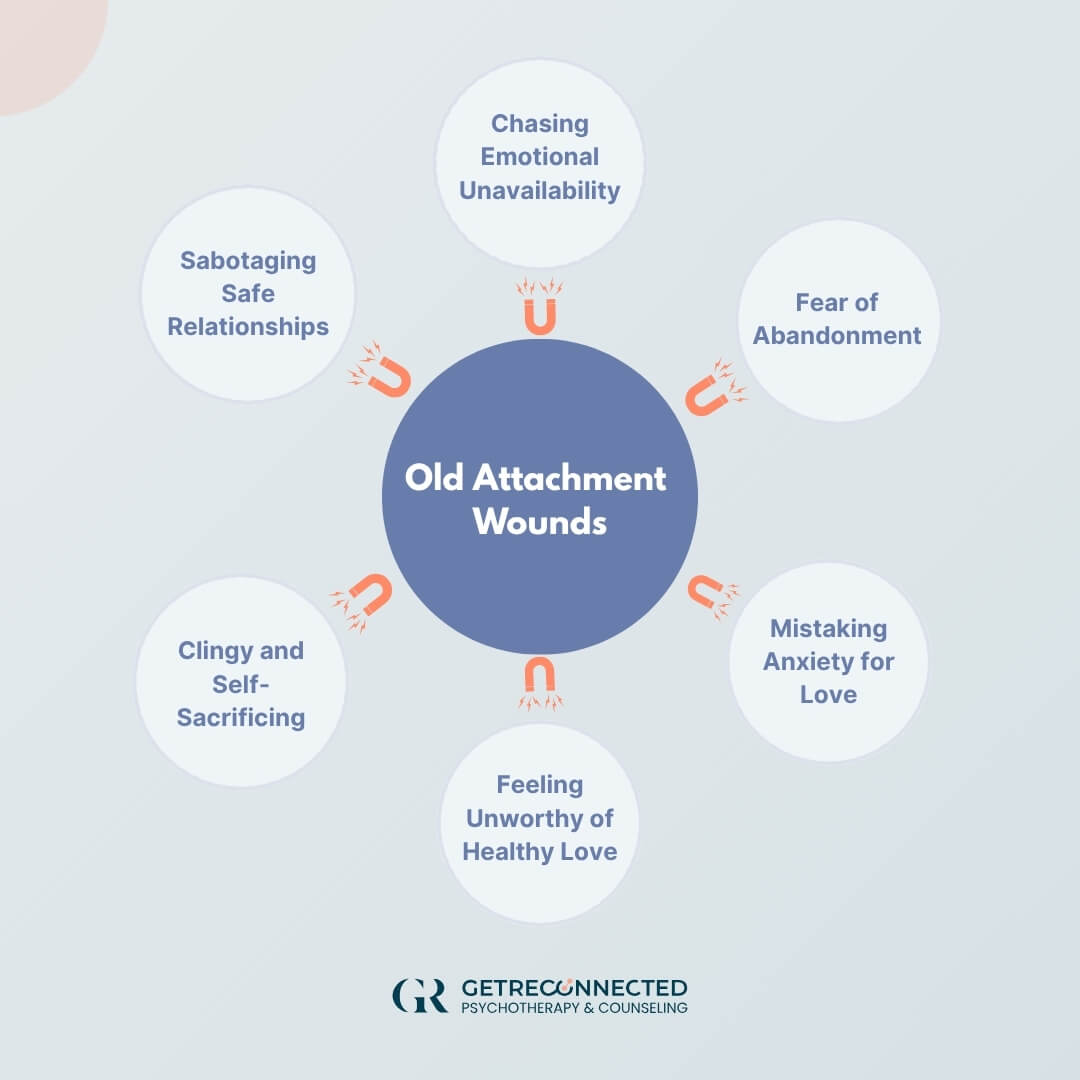
If this feels familiar to you, you might be shut down emotionally in some relationships while anxiously chasing others. You might be dealing with an old pattern that keeps you stuck with someone emotionally unavailable.
Know you’re not alone, it’s something I see so often in the therapy room and conversations with friends.
You might find yourself:
- Chasing emotionally unavailable people, hoping to finally feel chosen.
- Fearing Abandonment – Feeling terrified someone will leave you the moment you get close.
- Confusing unpredictability and emotional highs and lows with passion or love – Mistaking anxiety for connection.
- Believing you’re somehow unworthy of stable, healthy, reliable love.
- Becoming overly anxious, clingy, or self-sacrificing to hold onto someone.
- Pulling away or sabotaging relationships when they start feeling too good, because deep down it feels unsafe or unfamiliar.
It’s not your fault if you’ve found yourself in these patterns.
You didn’t consciously choose partners who couldn’t meet your needs, you unconsciously gravitated toward dynamics that felt familiar, hoping that this time it might turn out differently.
It’s a really human thing to do when you’re carrying an old wound you didn’t ask for.
According to attachment theory, these patterns are often adaptive responses to inconsistent caregiving.
The Impact of Chasing Emotionally Unavailable Partners
Why We Are Drawn to Emotionally Unavailable People
I want to be honest with you, this is one of those patterns that feels confusing because logically, you know better. You might tell yourself, “I deserve someone who chooses me,” but then find yourself drawn to the exact kind of person who won’t. I say this without judgment because I’ve been there too, and so have so many of my clients.
What’s happening beneath the surface is that your nervous system is wired to associate love with uncertainty. If your husband or partner feels distant, it might trigger familiar feelings from the past. That sense of unpredictability can feel like passion, even if deep down you know something is missing.
If love in your childhood felt unpredictable, conditional, or came with strings attached, then relationships where love feels just out of reach might actually feel familiar, even if they aren’t healthy. That familiarity can feel a lot like chemistry or passion.
It is important for me to point out, this isn’t you sabotaging yourself for no reason. It’s not because you’re weak or broken or don’t want to be happy. It’s because a part of you, likely your younger self or ‘inner child’, is still trying to earn the love and validation you needed back then. That inner child hopes that if you can just make this emotionally distant partner finally choose you, it’ll rewrite the story of not being chosen before.
But chasing someone who’s emotionally unavailable is exhausting. It can leave you second-guessing yourself, overanalyzing every text, every interaction, and bending yourself in half trying to become what you think they’ll want, and it still won’t be enough, not because you’re lacking, but because they’re not available to receive it.
Consequences on Intimacy and Relationships
When you’re stuck in this dynamic, it can quietly drain you in ways you might not even realize right away. Over time, a relationship with an emotionally unavailable partner can leave you feeling anxious, disconnected, or unworthy of love.
Here’s what tends to happen:
- You may live in a constant state of uncertainty and anxiety, wondering where you stand.
- You over-function in the relationship, overextending yourself emotionally while your partner stays distant.
- You minimize your needs or suppress your feelings, terrified of being “too much” or scaring them off.
- When things fall apart, you blame yourself: “Maybe I was asking for too much” or “If I had been cooler, more low-maintenance, maybe they’d have stayed.”
- And then comes the grief. Not just over losing them, but over the part of you that keeps hoping this time will be different.
I’ve spoken to so many people (and honestly, I’ve felt this too) who describe chasing crumbs of attention, trying to prove their worth, and carrying this deep ache inside because no matter what they did, it was never enough. And when you grow up on crumbs, a crumb can feel like a feast.
But it isn’t. And you deserve so much more than crumbs.
Recognizing the Cycle of Emotional Unavailability
So how do you know if you’re caught in this pattern? If you might feel like you’re always proving your worth or chasing validation, your partner’s emotional unavailability could be recreating your earliest relational wounds.
Sometimes it can be so familiar, so ingrained, that it feels normal. But here are some signs you might be stuck in this loop:
- You’re magnetically drawn to emotionally unavailable people. They might feel exciting, intriguing, like a mystery you’re desperate to solve.
- People who show up consistently and express clear interest in you feel boring, or you find yourself doubting their sincerity.
- You make excuses for partners who ghost, pull away, or avoid emotional conversations.
“They’re just stressed.”
“They had a tough childhood.”
“They’re not good at expressing feelings.” - You suppress your own needs because you don’t want to risk being abandoned.
- When you try to open up emotionally, you either get shut down or it sends your partner running, reinforcing the belief that you’re “too much.”
And here’s a hard truth I had to come to terms with myself: when you keep choosing people who can’t meet your emotional needs, it’s usually not about them. It’s about an old wound you’re unconsciously trying to heal.

Overcoming Emotional Unavailability in Relationships
So, what do you actually do when you start to realize you’ve been caught in this cycle? When you notice you’re either chasing emotionally unavailable people, shutting down your own emotions, or finding yourself stuck between craving closeness and being terrified of it at the same time?
The good news is, awareness is where real change starts. Once you can see the pattern, you’re no longer at its control.
It doesn’t mean it’ll disappear overnight (spoiler: it won’t), but it means you can start responding differently, even in small ways that will eventually shift everything.
Steps to Recognize and Address Defensiveness
Let’s be honest, when we’ve spent years protecting ourselves emotionally, it can be tough to even notice when we’re shutting down, avoiding vulnerability, or pushing people away.
Emotional defensiveness often looks like:
- Changing the subject when things get serious
- Downplaying your feelings with humour
- Avoiding eye contact or brushing off compliments
- Getting uncomfortable when someone expresses care, affection, or concern
- Convincing yourself you don’t need anyone, even when you desperately crave connection
If you’re nodding along, you’re not alone. I’ve caught myself doing this too, even after years of inner work. It’s natural to want to protect the parts of you that were hurt before.
How to Start Addressing It:
- Pay attention to moments when you feel uncomfortable with closeness. What’s happening in your body? Are you clenching your jaw, avoiding eye contact, changing the topic?
- Notice your inner dialogue at that moment. Are you thinking, “This is too much,” or “I shouldn’t need this” when someone gets emotionally close?
- Practice pausing before reacting. If you notice yourself getting defensive, you don’t have to immediately fix it, just name it internally: “I’m feeling defensive right now.” That awareness alone starts to soften the response.
And remember – defensiveness isn’t a flaw; it’s a protector part of you trying to keep you safe. You don’t need to fight it, just get curious about it!
You might also explore using the SAFE Model—Self-Awareness, Acceptance, Framework of Needs, Empowered Choices—as a guide to work through these defenses.
5 Strategies For Healthy Relationships
Once you start noticing your patterns, the next step is learning how to create healthier, more emotionally safe connections, both with yourself and with others.
This may mean having to tell your partner what you need, even if it feels vulnerable, or talking to a therapist to explore your childhood experiences and relational wounds.
Here are some strategies I often recommend to my clients:
-
Get clear on your needs
So many of us grew up learning to suppress what we wanted, so when someone asks “What do you need right now?” it can be surprisingly hard to answer. Start by checking in with yourself regularly: Am I craving connection, reassurance, space, validation? -
Normalize expressing those needs
It might feel terrifying at first, but saying things like “I’m feeling anxious right now and need a little reassurance” or “I’d love to hear how you’re feeling about us” opens the door for emotional closeness. -
Set boundaries with emotionally unavailable people
If you’re dating someone who constantly leaves you guessing, it’s okay to say, “I’m noticing I feel anxious not knowing where I stand. I need clarity and consistency in order to feel safe in a relationship.” If they can’t meet that, it tells you everything you need to know. -
Stop romanticizing inconsistency
I know the emotional rollercoaster can feel addictive, but healthy love is steady, not boring. Pay attention to how your nervous system responds to calm, consistent care. It might feel unfamiliar, but it’s what you deserve. -
Cultivate friendships and community that model emotional safety
Surround yourself with people who are emotionally available and who meet you where you are. It makes a huge difference in what you start to accept as normal.
How to Become More Emotionally Available
Sometimes, what can happen is, after years of chasing emotionally unavailable people, we ourselves become emotionally unavailable. It’s a survival response. You might keep people at a distance, fear vulnerability, or tell yourself you’re fine alone because getting too close feels risky.
Ways to Start Opening Up:
-
Let yourself feel what you feel, without judgment
Notice when you’re sad, anxious, hurt, or excited, and practice just sitting with those emotions instead of immediately distracting yourself or rationalizing them away. -
Take small risks with safe people
You don’t have to pour your heart out on a first date or tell your life story to a new friend. Start by sharing small pieces of yourself (your fears, your hopes, the things that matter to you). -
Practice staying present when things get emotionally intense
Instead of mentally checking out or numbing when conversations get deep, notice your body’s signals (clenched jaw, racing heart, urge to change the subject) and gently breathe through it. It’s okay to be uncomfortable, you’ll slowly build your tolerance for vulnerability. -
Revisit your inner child
The part of you that fears closeness or believes love is earned was likely formed in childhood. Spend time reconnecting with them through inner child journaling, visualization, or therapy. -
Explore earned secure attachment
Even if you didn’t grow up with secure relationships, you can develop earned secure attachment in adulthood through healing, self-awareness, and consistent, emotionally safe connections. It’s a process, not an overnight shift, but it’s absolutely possible.
Key TakeAways
If you’ve made it this far, I just want to take a second to tell you, I’m proud of you. I know how hard it can be to face these patterns and admit to yourself that something isn’t working. It takes so much courage to get honest about the ways we’ve been protecting ourselves and the wounds we’ve carried quietly for years. You don’t have to have it all figured out right now. Healing happens in small ways, like when you pause, notice, and choose to try something different.
Looking for Support?
If you’re sitting with all of this and thinking, “Okay… but where do I even start?”, you don’t have to do it alone.
This is exactly the kind of work I help my clients with in therapy: unpacking old patterns, understanding where they came from, and learning how to build healthier, safer connections.
If this blog felt like it spoke to your heart, book a free 15-minute consultation with me so we can talk about your struggles and how I can be of support to you.
Article Source : getreconnected.ca/why-choos...
